LESSON PLAN SUBJECT
MATHEMATICS CLASS 10+1
Lesson plan for maths class XI Limits & Derivatives cbse lesson plans for
mathematics teachers, lesson plan for maths class
XI, lesson plan for maths
teacher in B.Ed.
RMB DAV CENTENARY PUBLIC SCHOOL NAWANSHAHR |
NAME OF THE TEACHER | DINESH KUMAR |
CLASS | XI | CHAPTER | 12 | SUBJECT | MATHEMATICS |
TOPIC | Limits & Derivatives | DURATION : 20 Class Meetings |
PRE-
REQUISITE KNOWLEDGE:
Green Board,
Chalk, Duster, Charts, smart board,
projector, laptop etc.
Lecture method, Demonstration and scaffolding method of teaching.
LEARNING OBJECTIVES:-
- Introduction of derivatives as it is the rate of
change of distance functions.
- Introduction of the derivatives geometrically.
- Intuitive idea of limits.
- Limits of polynomial, rational, trigonometric, logarithmic
and exponential functions.
- Definition of derivatives relate it to scope of
tangent of the curve.
- Derivative of sum, difference, product and quotient of
functions.
- Derivatives of polynomial and trigonometric functions.
LEARNING OUTCOMES
- After studying this lesson student should know
- The term limits and derivatives.
- Students should know the different method of finding the limits, left hand limit , right hand limit,
- Method of finding the derivative by first principal,
- Product rule and quotient rule of the derivatives and different methods of finding the derivatives.
RESOURCES
NCERT Text Book,
NCERT Exemplar Book of mathematics,
Limit, Left-Hand Limit (LHL) , Right-Hand Limit (RHL), Finite
Limit, Infinite Limit, Limit at a Point, Continuity (Basic Idea), Standard
Limit, Rationalization, Factorization, Substitution Method, Derivative, Differentiation,
Independent Variable, Dependent Variable, Function, First Principle of
Derivative.
CONTENT OF THE TOPIC
- Derivative by First Principal
- Left Hand Limit and Right Hand Limit
- Different methods and formulas of derivatives
PROCEDURE
:
Start the
session by asking the question related to the algebraic identities, simple
algebraic calculations and some formulas of trigonometry. Now give some
introduction of limits and derivatives and introduce the topic limits and
derivatives step by step as follows.
[Explanation of limits]
[Explanation of Derivatives]
IntroductionToday, we begin one of the most important topics in
Mathematics—Limits and Derivatives. This chapter forms the foundation of
Calculus, a branch of mathematics developed to study change and motion.
Calculus has wide applications in science, engineering, economics, medicine,
and many other fields.
The concept of a limit helps us understand the value
that a function approaches as the input gets closer and closer to a particular
point. It enables us to analyze the behaviour of functions even when the
function value at that point is not directly known.
Definition of LimitSuppose f is a real function on a subset of the real numbers and let c be a point in the domain of f. Then f is continuous at c if
Undefined terms:
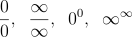 all these terms are called undefined terms
Left Hand Limit and Right Hand LimitIf at any point c given function have two different values then at that point (c) we calculate LHL and RHL. and the limit exist if
Left Hand Limit = Right Hand Limit = f(c)
LHL is denoted by )
RHL is denoted by )
When limit exist then
=\lim_{x\rightarrow%20c^{+}}f(x)=f(c))
For a function f(x) the limits ) and
and ) may or may not exist
may or may not exist
If both limits and exist, they may not be equal.
If \;\neq\;\lim_{x\to%20a^{+}}f(x)) then
then ) does not exist
does not exist
If \;=\;\lim_{x\to%20a^{+}}f(x)) , then exist and is equal to the common limit.
, then exist and is equal to the common limit.
A function is said to be continuous if its limit exist or if =f(c)) or if
or if
Left Hand Limit = Right Hand Limit = f(c)
Derivatives
Building on the concept of limits, we define the derivative
of a function. A derivative measures the instantaneous rate of change of
one quantity with respect to another. Geometrically, it represents the slope
of the tangent to a curve at a given point, while in real life it helps us
calculate quantities such as velocity, acceleration, growth, and decay.
Derivative by First Principal =\lim_{h\to0}\frac{f(x+h)-f(x)}{h})
Different methods and formulas of derivativesNow explain Algebra (sum and difference ) of derivatives of functions, derivative of polynomial and trigonometric functions. Product rule and quotient rule of polynomials.
Derivative of logarithmic and exponential functions with all formulas of derivatives and their use in different problems.
STUDENTS
DELIVERABLES:-
- Review questions given by the teacher.
- Students should prepare the presentation individually or in groups on the
formulas of limits and derivatives.
- Solve
NCERT problems with examples.
EXTENDED LEARNING:
DIFFERENTIAL LEARNING
For Below Average Students
- Charts , Models and activity
For Average Students
- Learning situations through watching video, creating collage, completing puzzles, assignment.
For Above Average Students:
- Higher Order Thinking Skill questions
SKILLS ENHANCED
Observation skill, analytical skill, critical thinking, team work, constructive approach, interpersonal skill, engagement in learning process etc.
ASSESSMENT TECHNIQUES:
- Assignment sheet (Home Assignment) will be given as home work at the end of the topic.
- Separate sheets which will include questions of logical thinking and Higher order thinking skills will be given to the above average students.
- Class Test , Oral Test , worksheet and Assignments. can be made the part of assessment.
- Re-test(s) will be conducted on the basis of the performance of the students in the test.
Competency based assessment can be taken so as to ensure if the learning outcomes have been achieved or not. e.g.- Competency Based Assessment link: M C Q
THANKS FOR YOUR VISIT
PLEASE COMMENT BELOW
🙏




Great Job Sir , Keep it up
ReplyDeletegreat sir.
ReplyDelete