Mathematics Lab Activity-10 Class XII
Mathematics Laboratory Activities 09 on Applications of Derivatives for class XI Non-Medical students with complete observation tables strictly according to the CBSE syllabus.
Chapter - 06
applications of derivatives
Activity - 10
Objective
To find the time when the
area of a rectangle of given dimensions become maximum, if the length is
decreasing and breadth is increasing at given rates.
Material Required
Chart paper, paper cutter,
scale, pencil, eraser, cardboard.
Procedure
1. Take a rectangle R1 of
dimensions 16 cm x 8 cm.
2. Let the length of the rectangle is
decreasing at the rate of 1cm/second and the breadth is increasing at the rate
of 2cm/second.
3. Cut other rectangles R2 , R3
, R4, R5, R6 , R7, R8, R9,
etc. of dimensions 15 cm x 10 cm, 14 cm x 12 cm, 13cm x 14 cm, 12 cm x 16 cm,
11 cm x 18 cm, 10cm x 20 cm, 9 cm x 22 cm, 8cm x 24 cm.
4. Paste all these rectangles on a card
board as shown in figure 10.1.
5. The length of the rectangle decreasing at the rate of 1cm/s and breadth is increasing at the rate of 2 cm/s.
6. Area of the given rectangle R1
= 16 x 8 = 128 cm2.
7. Area of the given rectangle R2
= 15 x 10 = 150 cm2 (after 1 sec)
8. Area of the given rectangle R3
= 14 x 12 = 168 cm2 (after 2 sec)
9. Area of the given rectangle R4
= 13 x 14 = 182 cm2 (after 3 sec)
10. Area of the given rectangle R5
= 12 x 16 = 192 cm2 (after 4 sec)
11. Area of the given rectangle R6
= 11 x 18 = 198 cm2 (after 5 sec)
12. Area of the given rectangle R7
= 10 x 20 = 200 cm2 (after 6 sec)
13. Area of the given rectangle R8 = 9 x
22 = 198 cm2 (after 7 sec)
Observations
1. Area of the rectangle R1 = 128 cm2.
2. Area of the rectangle R2
(after 1 second) = 150 cm2.
3. Area of the rectangle R3
(after 2 second) = 168 cm2.
4. Area of the rectangle R4
(after 3 second) = 182 cm2.
5. Area of the rectangle R5
(after 4 second) = 192 cm2.
6. Area of the rectangle R6
(after 5 second) = 198 cm2.
7. Area of the rectangle R7
(after 6 second) = 200 cm2.
8. Area of the rectangle R8
(after 7 second) = 198 cm2.
9. Area of the rectangle is maximum after 6
seconds and the Maximum
area of the rectangle is 200cm2
Result
Maximum area of the
rectangle is 200cm2 after 6 seconds.
Applications
This activity is used in
explaining the concept of rate of change of quantities
VIVA – VOICE
Q1. Define rate of change of function y = f(x)
Ans. If a quantity y varies with another quantity x such that y = f(x), then  represents the rate of change of y w.r.t x.
Q2. What symbol is used to write rate of change of y w. r. t. t ?
Ans.  .
. Q3. What symbol is used to write rate of change of y w. r. t. x ?
Ans.
Q4. What is chain rule ?
Ans. 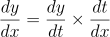 .
.
THANKS FOR YOUR VISIT
PLEASE COMMENT BELOW





Comments
Post a Comment